
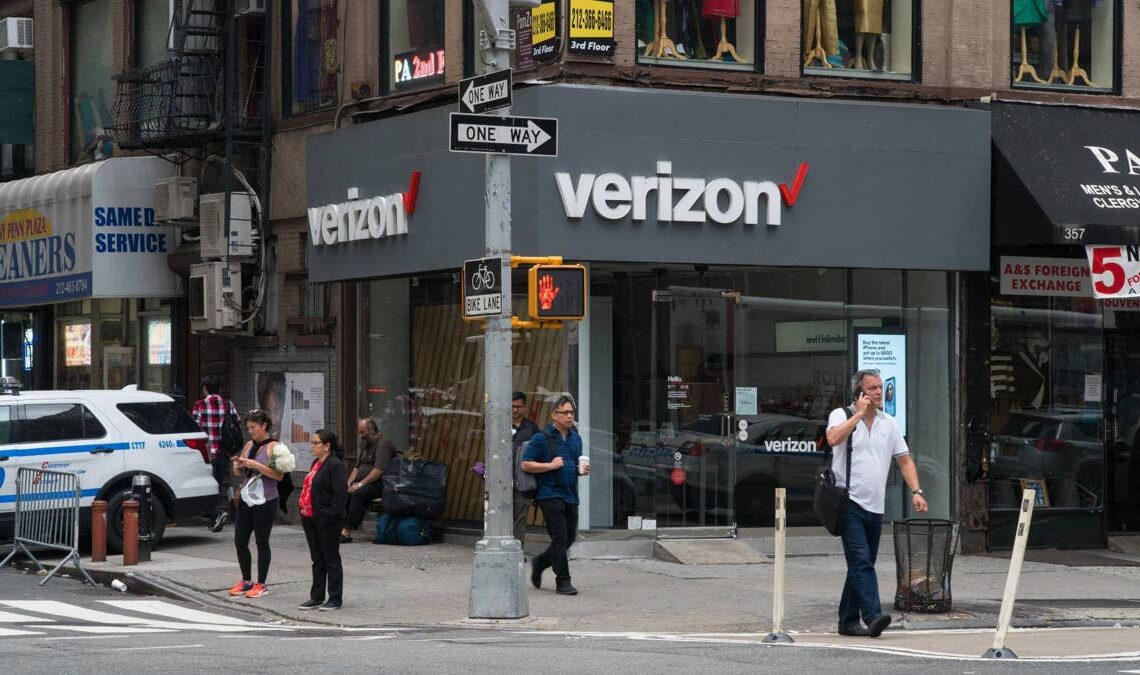
Verizon is planning to discontinue a longtime phone service as wireless demand in the U.S. grows rapidly. Consumers are increasingly relying on wireless technology to power streaming services, artificial intelligence, wearables, and more.
Americans used 159.3 trillion megabytes of data in 2025, according to a recent survey from CTIA, a 20% increase from the previous year. Since 2018, when 5G launched, the wireless industry has spent $250 billion to meet this demand by building sites, upgrading infrastructure and expanding new offerings like 5G home internet.
Verizon has followed that industry shift by investing heavily in newer technologies. In its first-quarter 2026 earnings report, the company said it expects to spend $16 billion to $16.5 billion on capital expenditures this year, supporting its mobile network, 5G capacity, fiber expansion and broadband services.
As Verizon and other providers continue shifting toward newer network technologies, some older services are becoming less central to their networks.
Verizon seeks to end landline phone service in 9 states
This growing reality is why Verizon has asked the Federal Communications Commission for approval to discontinue traditional copper landline phone service in nine states.
In an FCC filing, Verizon states that it seeks to retire “plain old telephone service” (POTS) in “portions of Arizona, Delaware, New Jersey, New Mexico, Ohio, Rhode Island, South Carolina, Utah, and Virginia,” impacting approximately 277,000 residential and business legacy voice lines.
Verizon said that it spends billions of dollars annually to maintain its legacy copper network. It emphasized that these costs are “enormous” due to the “rising costs of copper and the need for replacement parts that are increasingly difficult to procure as obsolete equipment is discontinued.” It also warned that copper is “prone to theft.”
Related: Verizon scales back a perk that keeps prices low for customers
“Copper infrastructure is too slow to meet modern needs, many decades old, costly to maintain, and vulnerable to damage and theft,” said Verizon in the filing.
The company said that if the FCC approves this transition, it will be able to “advance the Build America Agenda” by allowing it to “direct investments toward the high-speed networks that Americans want and away from maintaining the legacy copper networks that they are abandoning.”
The request from Verizon follows in the footsteps of AT&T, which is also transitioning away from its legacy copper landline network. AT&T expects to complete this change in 2029.
In a July Light Reading report, Roger Entner, a lead analyst at Recon Analytics, emphasized that the era of the copper telephone loop, which has been around since the 1800s, is “over.”
“A pair of copper wires carries a few megabits on a good day, corrodes in the rain and is worth enough as scrap that thieves cut it out of the ground,” he said. “Fiber carries thousands of times the capacity over the same route and costs less to run once it is in.”
“Fixed wireless and satellite now reach the hardest addresses for a fraction of what new copper costs to deploy,” he continued. “There is no measure left on which copper wins.”
Shutterstock/Brandon Klein
What this change means for Verizon customers
Verizon has updated its website to outline the benefits customers will see when it replaces these copper lines with “reliable alternatives” such as fiber and wireless.
It highlights that customers who switch to these newer options can keep their current phone number and continue to access emergency services on legacy devices. Also, the equipment for fiber and fixed wireless services includes battery backup to keep customers connected during power outages.
Verizon clarifies that it will not discontinue a customer’s existing copper voice service if the customer lacks access to a replacement service.
It informs customers that “no immediate action is required” and that their service will “continue without interruption.” The carrier also said it will provide customers affected by the change with a written notice.
In a Facebook post, a Verizon customer shared a letter they received about the change. The carrier states in the notice that the change, which is subject to FCC approval, will occur “on or after November 30, 2026.”
It specifically highlights that the services that are being discontinued are “copper-based dial tone base home phone service” offered as “Residence Dial Tone Service,” “Basic Service Access Line,” and “Individual line.”
Verizon also states that impacted customers “will have at least one fiber, cable, or mobile wireless voice option available. Many customers will be able to choose modern Verizon voice service over wireless or fiber.”
Verizon sees stronger wireless and fiber demand
The move from Verizon comes as the company continues to see growth in its wireless and fiber internet businesses.
In the second quarter of 2026, Verizon added 184,000 postpaid phone customers and 155,000 fiber broadband customers during the quarter, according to its latest earnings report.
However, Verizon is seeing demand dip for its fixed wireless access (FWA) internet service. It gained only 193,000 new FWA customers during the quarter, which is 30.6% fewer than it added in the same time period in 2025.
More Verizon News:
- Verizon CEO doubles down on removing free offers for customers
- Verizon shuts down longtime customer support option after layoffs
- Verizon acquires 35-year-old wireless carrier as it shuts down
Verizon CEO Dan Schulman said on an earnings call in July that more customers are joining the company’s fiber internet service than its FWA service, driven by its rapid fiber expansion.
To help fuel growth in its wireless and broadband businesses, Verizon recently rolled out new offerings targeting value-conscious customers. In June, it launched its Simplicity plan, which offers customers wireless service for $45 a month.
It also introduced its Verizon One plan, which offers combined mobile and home internet service for $70 per month.
Related: T-Mobile and Verizon face a new broadband rival