
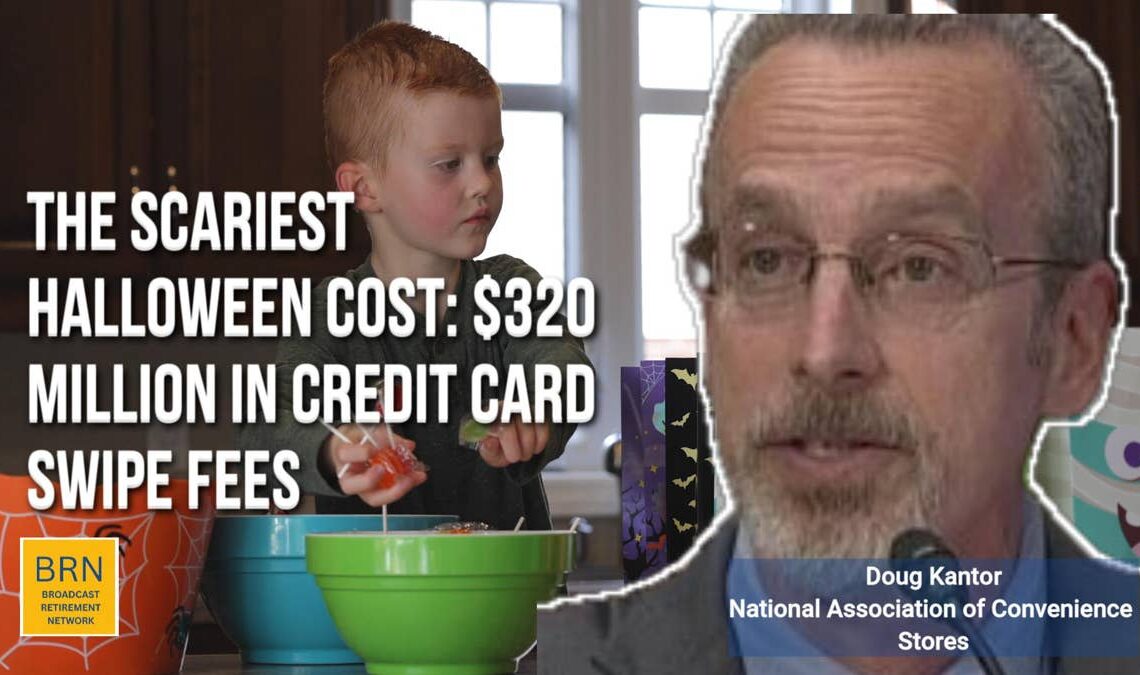
Doug Kantor of the National Association of Convenience Stores examines how credit card swipe fees add nearly $320 million to Americans’ Halloween spending, increasing the cost of candy, costumes and decorations.
Transcript:
Jeffrey Snyder, Broadcast Retirement Network
Well, Doug, it’s always great to see you. Thanks for popping by the program again this morning.
You bet. Thanks for having me on. You didn’t come dressed up in Halloween, but we’re going to talk about Halloween in particular.
Let me ask you about swipe fees, because according to your latest research, $320 million will be added to the cost of Halloween candy and other goods as a swipe fee. That seems like a lot of money to me.
Doug Kantor, National Association of Convenience Stores
It is a lot of money, and it feels like a lot of money to American families. We’re in this real problem where people feel like they can’t afford the things they need or can’t afford them as well as they used to, and these credit card swipe fees are a hidden part of that problem on everyday purchases of just about everything we buy.
Jeffrey Snyder, Broadcast Retirement Network
If you wouldn’t mind, and I’m just doing it for my own edification, what is a swipe fee? Is it the cost of actually transferring the amount of money electronically from one issuer to another?
Doug Kantor, National Association of Convenience Stores
It’s not, actually. What’s interesting about this credit card swipe fee is it’s not related to any cost. It’s the fee that the bank that gives you or me our credit cards charges to the store where we buy things, but it’s inflated beyond any semblance of any cost.
In the United States, actually, these fees are higher than anywhere else in the world, and it’s by several multiples. In Europe, for example, they’re less than one-seventh of what they are here, and you know what? The credit card companies make plenty of money in Europe, too.
Jeffrey Snyder, Broadcast Retirement Network
Well, and they do. There’s double-digit annual percentage rates that they charge if you hold onto debt for a period of time. This amount, how does it get determined?
The convenience store or the retailer pays this. I’m presuming, Doug, they pass that through to the consumer in those cases, like you and me and the families out there.
Doug Kantor, National Association of Convenience Stores
They do. Well, first, how it gets said is Visa and MasterCard dictate the fees that all the banks that issue credit cards charge, and that’s a big part of the problem. It’s essentially price fixing, but we’ve let it go on for years and years.
At the store, the average retail store has a very thin profit margin. The fees are just about as big as the store’s profit margin on average, so either they pass it along to you and I as consumers or they go out of business. That’s not much of a choice.
Jeffrey Snyder, Broadcast Retirement Network
Yeah. I guess I’m a big fan of competition and open competition. That should drive the cost of a particular good or service.
What gives these card issuers the … Is there a law or regulation that gives them the flexibility to charge whatever they want?
Doug Kantor, National Association of Convenience Stores
There’s no law or regulation. What’s remarkable about this is many other countries have regulated this area, but the United States hasn’t. There are regulations on debit cards, but not on credit cards, and so these fees have just skyrocketed.
In particular, they’ve skyrocketed not only because they keep increasing them, but also because what they do is set them as a percentage of the amount of a transaction, which means anytime there’s inflation on anything else, the credit card fees automatically go up.
Jeffrey Snyder, Broadcast Retirement Network
So we live in a different world. I grew up with credit cards, not having credit cards, but as a kid, I remember my parents having credit cards and they used to cut them up and give me a little one so I could put it in my little kid wallet because I felt like I was a grown-up, but credit cards have really grown in usage, but so have alternative ways of paying for goods. We’ve got Venmo, we’ve got Stripe, we’ve got all these different ways of transacting now.
Are those suitable alternatives or is there a way to allow people to choose or retailers or convenience stores to choose what method they can use, I guess, if I can use a better term?
Doug Kantor, National Association of Convenience Stores
I wish there was a better choice there. Those alternatives you talk about, the Venmos, the Stripes, et cetera, are a tiny pinprick compared to overall credit card fees, excuse me, overall credit card spending. And many of them, if you take PayPal just as one example, actually all it is is you’ve put your credit card into that app or program.
It’s nice, those are good services, but they don’t really get around this central problem, which is that Visa and MasterCard between them control virtually all the banks and what they do on this credit and debit card spending. And it’s that monopoly or in this case, duopoly problem that leaves anybody without real alternatives, at least alternatives that are of any size that makes a difference here.
Jeffrey Snyder, Broadcast Retirement Network
Yeah. I mean, I don’t want to, I’m not the type of person that wants to get in the way of someone earning a buck or in this case, many bucks, but is there legislation or things in front of the Congress? I know we were talking about this before, there’s an election going on, Congress is out campaigning, but is there a bill or an act that is out there today that maybe addresses this circumstance?
Doug Kantor, National Association of Convenience Stores
Yes. So there’s legislation called the Credit Card Competition Act. And look, we are very much in favor of people earning a buck.
I represent little convenience stores. They want to make money. They don’t just run the store out of the goodness of their hearts.
They hope people like it, but they’re there to make money. And the credit card company should be too. Don’t blame them for that, but they should have to compete like everyone else.
And that’s what the legislation requires. And it only applies to the 28 or so largest banks in the country and says, Hey, you guys should just give people a competitive choice so that it’s not all one way. And it’s not just this price fixed fee.
That’s all it does. It still lets them make plenty of money.
Jeffrey Snyder, Broadcast Retirement Network
So has this act been taken up in the Congress for debate? Again, I mentioned I think everyone knows because of all the ads and whatnot that we have an election. Congress is out campaigning.
The new Congress will start, I guess they’ll come back in December. Have they picked up this bill to debate it on the floor, either in the House or the Senate?
Doug Kantor, National Association of Convenience Stores
So they’ve had committee hearings on this bill and there’s been a lot of attention on it. So our hope is that soon it will go to the floor and get a vote. Hasn’t quite reached that point yet, but there’s a very broad coalition of folks supporting it, not just business groups, but labor unions, consumer groups, public interest groups, Native American tribes, you name it.
Almost everybody at the end of the day, if you know about it, you get hit with these fees and think, Hey, this doesn’t make any sense.
Jeffrey Snyder, Broadcast Retirement Network
Yeah. You know, from the perspective of, I guess, common sense, I would think, you know, small businesses in particular, of which I am one, the network is one, and people that you represent are typically smaller businesses. I mean, they are the lifeblood of the American economy.
We need those types of businesses. They employ probably among the most people, right? So we need them to continue to survive.
You said that it’s been in committee, it’s been debated. How does it get from committee, if I can ask, but maybe this is a, you know, schoolhouse rock type of question, but how does it go from committee and dating myself to the floor for consideration?
Doug Kantor, National Association of Convenience Stores
Yeah, it is one of those schoolhouse rock type questions. Nowadays, Congress usually works a little different than the old schoolhouse rock model. I mean, sometimes it goes through a committee where they have a hearing, they have a markup, the committee reports it out, it goes to the floor, passes through one, you know, the House or the Senate, and then goes over to the other body.
More often now, just given the state of Congress and partisan politics, things wait until there’s one big bill and a bunch of smaller bills get considered along with it, and either get attached to it, or there are amendments on the floor. It’s that type of situation. So often there’s kind of a long time of waiting, and then things happen all of a sudden.
And that’s more often how Congress works today.
Jeffrey Snyder, Broadcast Retirement Network
All right, so it’s no longer schoolhouse rock, it’s some other derivation of that. That’s fine. You know, everyone talks about affordability, we’re all facing challenges.
I know that states have relaxed, and the federal government have relaxed some of the taxes on gasoline, as an example. That should help, I guess, economically, theoretically, reduce prices. It would seem to me that if you’re for people being able to afford things, right, that taking off the things on top of the cost would make sense.
So when Congress returns after the election, do you expect this to be picked up? Does this get picked up as part of like, for example, a funding bill? Because don’t they always have to come back?
You know, I’m not as close to it as you are. But don’t they always have to, you’re always reading about them having to come up with a reconciliation or a funding bill to fund the government? Is this something that would get attached there?
Doug Kantor, National Association of Convenience Stores
I think there’s a very good chance of that. There are a number of things that might come up in Congress between Election Day and the first of the year. They’ve got those government funding bills, they’ve got a farm bill, they’ve got a defense bill, the list is actually pretty long, a highway bill, you name it.
And so not clear exactly what will come up and what won’t. But it’s certainly our hope that they consider this Credit Card Competition Act when that happens. And, you know, the bill’s been out there for a long time.
It’s had a lot of consideration. We think it’s time for it to move soon.
Jeffrey Snyder, Broadcast Retirement Network
And we’re talking about Halloween, which is later this week. But this impacts Thanksgiving, all the major holidays, right? Anytime you go out and make a purchase, when you buy those gifts for loved ones in December, when you go to the pump to maybe buy gas from a local convenience store, right?
This is impactful. So it’s going to be here for Halloween and in perpetuity until it’s changed.
Doug Kantor, National Association of Convenience Stores
That’s exactly right. Look, these credit card fees impact the price of just about everything we buy. It’s hard to think of an example where it doesn’t apply.
And so it costs 18 pieces of candy at Halloween. That’s a lot of extra houses for every kid to have to try to go to just to get back to the same number of pieces of candy they were getting in past years. That’s really frustrating.
But it’s also, yeah, carving out part of your turkey at Thanksgiving and taking Christmas presents from under the tree. It doesn’t make any sense for us to allow this price fixing type system to take extra money from people who are just trying to get by and have a nice holiday with the family.
Jeffrey Snyder, Broadcast Retirement Network
Yeah, really well said. Well, Doug, we’re going to have to leave it there. I suspect we’re going to be talking about this into, I don’t want to jinx anything, but I suspect we’ll be talking about this in December and maybe into January when the new Congress is sworn in.
Always great to see you. Thanks for bringing this to our attention. And we look forward to having you back on the program again very soon.
Doug Kantor, National Association of Convenience Stores
Thanks very much. It’s great to talk to you.