
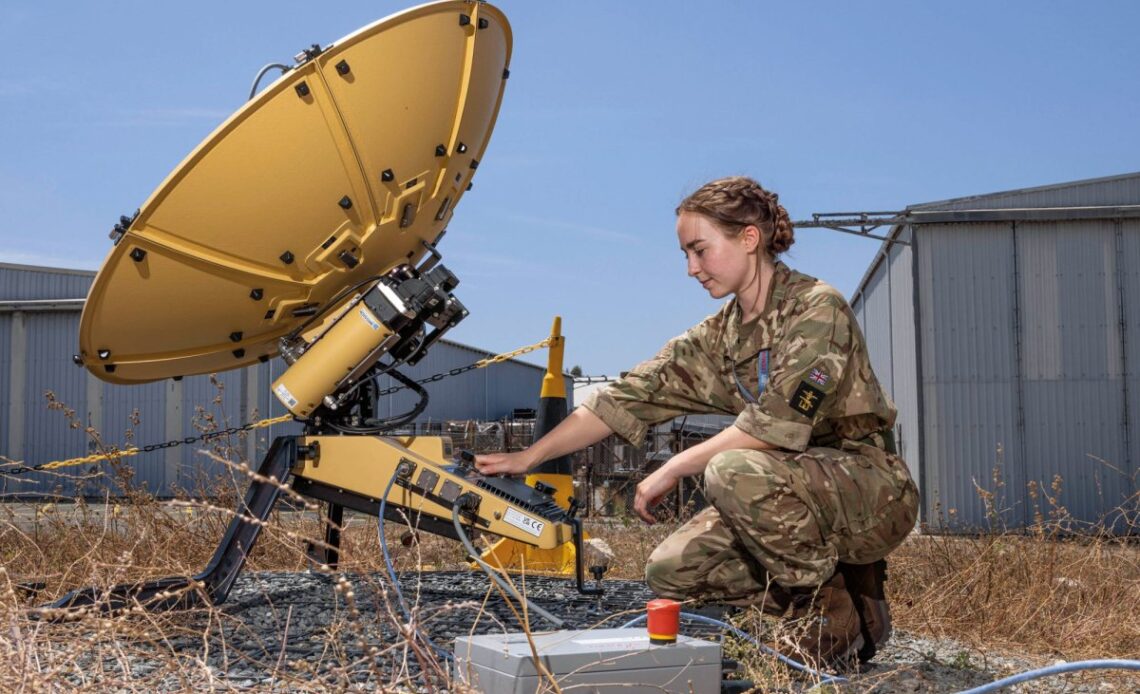
RAF cyberspace engineering technician in 2025 (UK MOD © Crown copyright 2025. Photo by Corporal Gareth McGarvie RAF)

9 min read2 hr
UK armed services are working towards a 30 per cent recruitment level for female personnel by the end of the decade. Zoe Crowther explores claims that forces women are still having to contend with ill-fitting body armour and inadequate underwear
Since 2018, all frontline combat roles have been open to women. Ten years later, women make up more than 10 per cent of British army personnel, but much of the equipment they are expected to wear has historically been designed around the male body. The consequences are not simply uncomfortable uniforms: ill-fitting body armour and inadequate breast support can put women’s health, performance and lives at risk.
The scale of the problem was highlighted in the Defence Select Committee’s 2021 inquiry into women in the armed forces. More than three-quarters (77 per cent) of serving women said they had been affected by ill-fitting or inappropriate uniform.
The consequences have been seen in other countries too. Ukrainian veteran Nataliia Lishchyshena drew international attention to the issue after undergoing a double mastectomy last year following severe injuries caused by her standard-issue body armour.
For Rebekah Polgar, founder of Cambridge-based defence innovation company Tigers Eye, the problem is one that the military has been too slow to recognise – and she says the Ministry of Defence (MoD) should also turn its attention to providing servicewomen with suitable underwear.
Established in 2022, her company develops science-backed breast support systems (BSS) and tactical equipment for servicewomen, police officers, firefighters, first responders and high-impact sports enthusiasts. Polgar founded the business following her own experience of ligament damage and surgery resulting from a lack of appropriate support equipment.
Drawing on her background in a military family and experience working with women on the front lines, she set out to address what she believes has been a significant blind spot in military procurement.
Beyond the protective plates worn by soldiers, Polgar says what women wear underneath their armour is also a significant, and frequently overlooked, part of the issue.
“Breasts are the biggest external difference between men and women, and have been ignored completely, but have the biggest implications around performance and health for women,” Polgar tells The House.
Polgar argues that the subject of breast support has received insufficient attention because it is still considered taboo. Women are often left to make do with general sports bras, rather than being provided with specialist underwear designed to support them during physically demanding military activity. General sports bras that are too compressive can cause damage when worn underneath ill-fitting armour, while those that do not provide sufficient support can lead to breast pain and other problems. In combat roles, inadequate support can also affect women’s ability to move and perform effectively.
The wider health implications are reflected in figures from the US military. In 2025, it spent more than $23bn on compensation payments for female personnel. One-third of military women in the US develop migraines despite not having experienced them previously, which Polgar says could be linked to pressure being exerted on a nerve in the shoulder, precisely where a bra strap sits.
She also points to the higher rate of musculoskeletal issues in female veterans.
“Out of the $23bn, just over $10bn is only spent on musculoskeletal issues, much of which is directly related to bras and armour: back pain, neck pain, shoulder pain, breast pain, finger numbness,” she says.
Tigers Eye saw its products deployed in active combat by Ukrainian soldiers within a year of its release, but it has yet to secure a ongoing contract with the British military. Polgar says this is particularly frustrating given that the company is based in the UK and is developing solutions to a problem the armed forces have acknowledged.
MPs are pressing for greater urgency. Alex Baker, Labour MP for Aldershot – “the home of the British Army” – sits on the Defence Committee and has been advocating greater investment in female-specific equipment.
She is frustrated that five years have passed since the Defence Select Committee report recommended improvements to equipment for women, with progress still falling short of what is needed.
Liberal Democrat MP Sarah Dyke, chair of the Women in Defence All-Party Parliamentary Group (APPG), says the situation as “absolutely shocking”, describing properly fitting body armour as “essential protection” for military personnel. The Liberal Democrat MP is concerned that focusing solely on body armour risks overlooking the wider deficiencies in military equipment.
“We can’t just look at body armour in isolation, the problem runs right across uniforms, specialist bras, helmets, footwear, and other kit as well,” she says.
“It’s absolutely ridiculous that, particularly when it comes to underwear, women aren’t being given the right kit to be able to do their jobs.”
The MoD has started to recognise the wider problem of ill-fitting body armour. This year, the MoD also backed a £3.9m contract with British manufacturer NP Aerospace to supply 2,000 sets of female-specific curved body armour plates to female soldiers in Ukraine.
The ministry has committed to introducing dedicated, curved armour for British female service personnel by 2029 through its newly initiated Complex Geometry Body Armour programme.
NP Aerospace, based in Coventry, is the main supplier of body armour to the UK armed forces. With more women joining the military and all frontline combat roles opened to them in 2018, the company has developed body armour shaped specifically for female bodies.
Its chief executive and owner, James Kempston, says the product was developed using British requirements and data, rather than being designed exclusively for the Ukrainian market.
“We developed this product specifically against the UK specifications,” he tells The House, describing how it was based on the UK MoD’s own anthropometric data and developed alongside the UK scientific community.
“If the MoD wanted armour plates today, we could deliver them in a three-month timeframe”
Kempston is concerned that the MoD’s procurement timetable could leave servicewomen exposed for years, despite a British-made solution already being available.
“If they wanted plates and they ordered plates today, we could deliver them in a three-month timeframe.
“My frustration is not about our position. It’s the fact that there will be women in combat situations right now that are not protected as well or can’t function the same as their male equivalents. That’s a recipe for injury or worse death.
“It’s made in the UK. We’re ready to go. I truly do think they shouldn’t wait to 2029. That’s so many years out.”
Baker agrees: “With a Defence Secretary that is saying that we need to be ready for war in 1,000 days, we are supposed to be maintaining some sort of level of readiness.
“We need to get the orders in to get this body armour in train because we do not want to be sending our women into circumstances where they could be at real risk without knowing that we haven’t got them the kit and equipment to actually put them in the best possible place to come out of those situations basically fit and healthy.
“There is a real need for government to move so much faster right across the board. Government is speaking the right language on this, but this is a problem right across the board in the MoD. It’s just incredibly slow to get contracts in place. The priority must be to getting that kit to service women without an unnecessary delay, and that includes the other specialist items of equipment as well.”
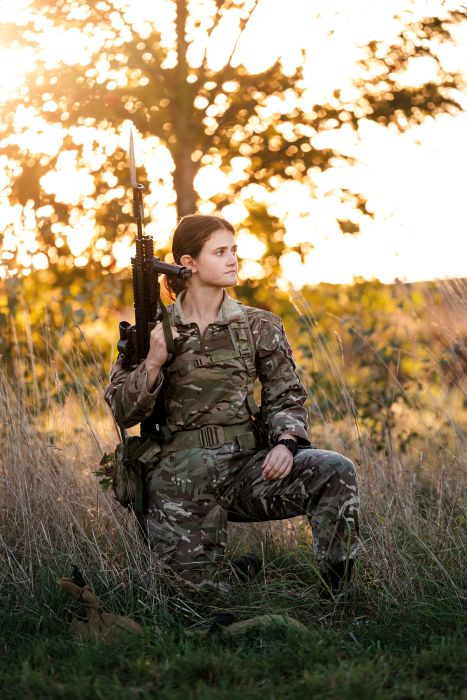
Dyke believes that female requirements should be central to defence procurement and the design of equipment “from the outset”, rather than treating them as an additional consideration once equipment has already been designed. “They shouldn’t be seen as an afterthought.”
The Women in Defence APPG will also examine the availability of appropriate kit across all three services – the army, Royal Navy and RAF – to establish whether improvements are being made consistently.
From 2024, female basic recruits in the field army were given a £50 annual allowance to spend on appropriate underwear. This has been recently upgraded to £100.
Polgar describes the initiative as a “tick-box exercise”, arguing that women are not given sufficient education about how to claim the voucher or what they should be buying.
For her, the problem is not a lack of funding but where defence spending is directed.
“The military likes spending money on flashy, expensive things and missiles. The problem is not not having money. There is money. They’re just spending it on the wrong areas.”
She says the slow pace of change might be reinforced by continued resistance to the wider principle of women serving in the military. At a Nato conference a few weeks ago, she says, senior military men told her women should not be in the military in the first place.
Dyke says that it has generally been accepted across military services “that we need to get better female representation across the defence enterprise” and push for 30 per cent female recruitment by 2030.
“That figure, I feel, is not going to be kind of achieved,” she says. “However, I think all of the work that has been put in place to meet that target obviously has then raised the profile of the importance of getting specialist equipment to women.
“If we want to incentivise more women into serving in the military, then we’ve got to provide them with the basic operational kit and equipment to be able to do that properly.”
In a statement, the MoD said: “The safety of our personnel is paramount, and we ensure everyone has access to the best equipment to protect themselves in combat.
“Female service personnel are currently issued scalable body armour available in a range of sizes and configurations, while maintaining consistent ballistic protection standards.
“Our world-first dedicated arduous training guide for women in the armed forces will set a new global standard for performance in the toughest roles, including better-designed clothing and improved-fit body armour.”