

Key Points
When markets correct or crash, one of the first thing investors should do is start to look for good stocks to pick up at discounts.
In the current market, large-cap valuations are extremely high: The Shiller CAPE (cyclically adjusted price-to-earnings) ratio sits at 42.15, the highest that market valuation metric has been since the peak of the dot-com bubble in 1999.
Missed Nvidia in 2009? This Rare Signal Is Flashing Again. In 2009, a “Double Down” signal flashed for a little-known chipmaker called Nvidia. For the first time in years, that same “Total Conviction” signal is flashing for a company 1/100th the size of Nvidia. Continue »
Should the market tank, there would be some great buying opportunities among some of these now-overpriced large caps — some of them, but not all.
Thatʻs why, if the market does tank, I would be looking to load up on the VictoryShares US Value Momentum ETF (NASDAQ: ULVM).
Image source: Getty Images.
Value and momentum
The VictoryShares US Value Momentum ETF employs a unique strategy that looks for large-cap stocks that are not only good values, but have forward price momentum.
The ETF tracks the Nasdaq Victory US Value Momentum index, which includes stocks within the Nasdaq US Large Cap 500 index with higher exposure to value and momentum factors. Each stock’s value score is calculated based on factors like price/earnings and other valuation ratios, while its momentum score is based on the stockʻs price trends over the last six months and 12 months, except the last month, adjusted for volatility.
Then, each stock is ranked by its combined value and momentum scores, and the top 25% are included in the portfolio. Stocks with lower volatilities are given higher weights in the ETFʻs portfolio.
The index is rebalanced and reconstituted quarterly, and the ETF’s portfolio follows suit. The ETF currently holds 124 stocks with Johnson & Johnson, Berkshire Hathaway, and Realty Income the three largest holdings.
Companies in the financial industry make up 29% of the portfolio, followed by healthcare and industrials at 11% each.
Beating the Nasdaq and the S&P 500
The strategy has worked well as the VictoryShares US Value Momentum ETF has outperformed the S&P 500 over the past 12 months with a total return of 29%.
Its three- and five-year average annualized returns are about 13%, which is roughly the same as the S&P 500. It does not yet have a 10-year track record, having only debuted in 2017.
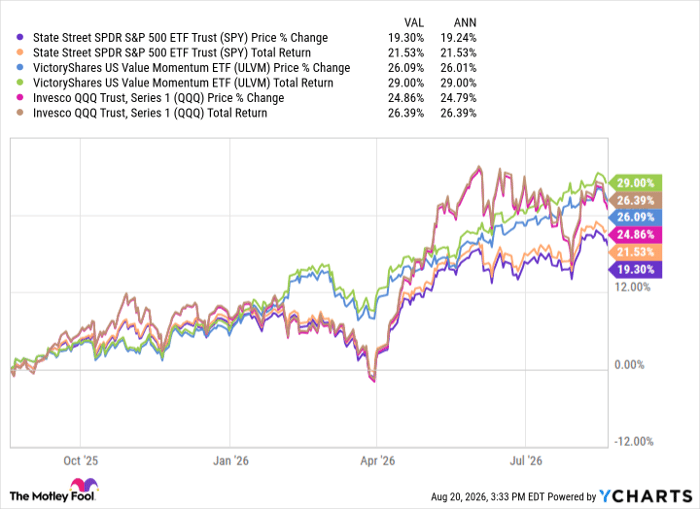
SPY data by YCharts.
So during an almost-four-year-long bull market when gains were dominated by magnificent megacaps and large tech stocks, its performance has kept pace with the S&P 500.
But where you should really start to see some separation between this ETF and the large-cap benchmarks is during a downturn, when value is key and momentum is paramount. Take 2022, for example, when the S&P 500 dropped by 19%. This ETF was only down 8% that year, a significant outperformance.
Yet, over the past three-plus years, when markets soared, the VictoryShares US Value Momentum ETF kept pace with the S&P 500. This is a good ETF in any market, but its strengths will really demonstrate themselves if there is a significant downturn.
Should you buy stock in Victory Portfolios II – VictoryShares Us Value Momentum ETF right now?
Before you buy stock in Victory Portfolios II – VictoryShares Us Value Momentum ETF, consider this:
The Motley Fool Stock Advisor analyst team just identified what they believe are the 10 best stocks for investors to buy now… and Victory Portfolios II – VictoryShares Us Value Momentum ETF wasn’t one of them. The 10 stocks that made the cut could produce monster returns in the coming years.
Consider when Netflix made this list on December 17, 2004… if you invested $1,000 at the time of our recommendation, you’d have $429,223!* Or when Nvidia made this list on April 15, 2005… if you invested $1,000 at the time of our recommendation, you’d have $1,317,883!*
Now, it’s worth noting Stock Advisor’s total average return is 965% — a market-crushing outperformance compared to 212% for the S&P 500. Don’t miss the latest top 10 list, available with Stock Advisor, and join an investing community built by individual investors for individual investors.
See the 10 stocks »
*Stock Advisor returns as of August 24, 2026.
Dave Kovaleski has no position in any of the stocks mentioned. The Motley Fool has positions in and recommends Berkshire Hathaway and Realty Income. The Motley Fool recommends Johnson & Johnson. The Motley Fool has a disclosure policy.